
Written by Luke Bayly, a digital strategist with 9+ years’ experience in web design and SEO. With a background in Engineering and Finance, Luke approaches small business websites as structured digital systems built for clarity, trust, and measurable outcomes.
If you run a local service business, “showing up on Google” cannot be achieved by just “a good website”. It is a system: inputs → signals → outcomes. Most small business owners waste money on local SEO in two predictable ways:
- They pay for “activity” (posts, random directories, generic blog packages) before fixing the foundation.
- They chase rankings without checking whether the website and Google Business Profile (GBP) can actually convert interest into enquiries.
Best practice is to diagnose before prescribing a solutions so we go through the process. This includes:
- A decision framework for what to fix first
- A GBP completion checklist (the fields that matter)
- A diagnostic table for common symptoms
- A prioritisation stack (fast wins vs defensible wins)
- A mini case breakdown with a quantified outcome
- Realistic expectations on timeline, cost, and ROI
- The agency tactics that quietly waste budget
If you want a shortcut to SEO mastery: local SEO is usually won by doing boring things correctly, in the right order.
Local SEO is a system you can self diagnose before you spend money
Local SEO (local search engine optimisation) means improving visibility when people search with local intent (often inside Google Maps) the map pack (the 3-map results), and localised organic results.
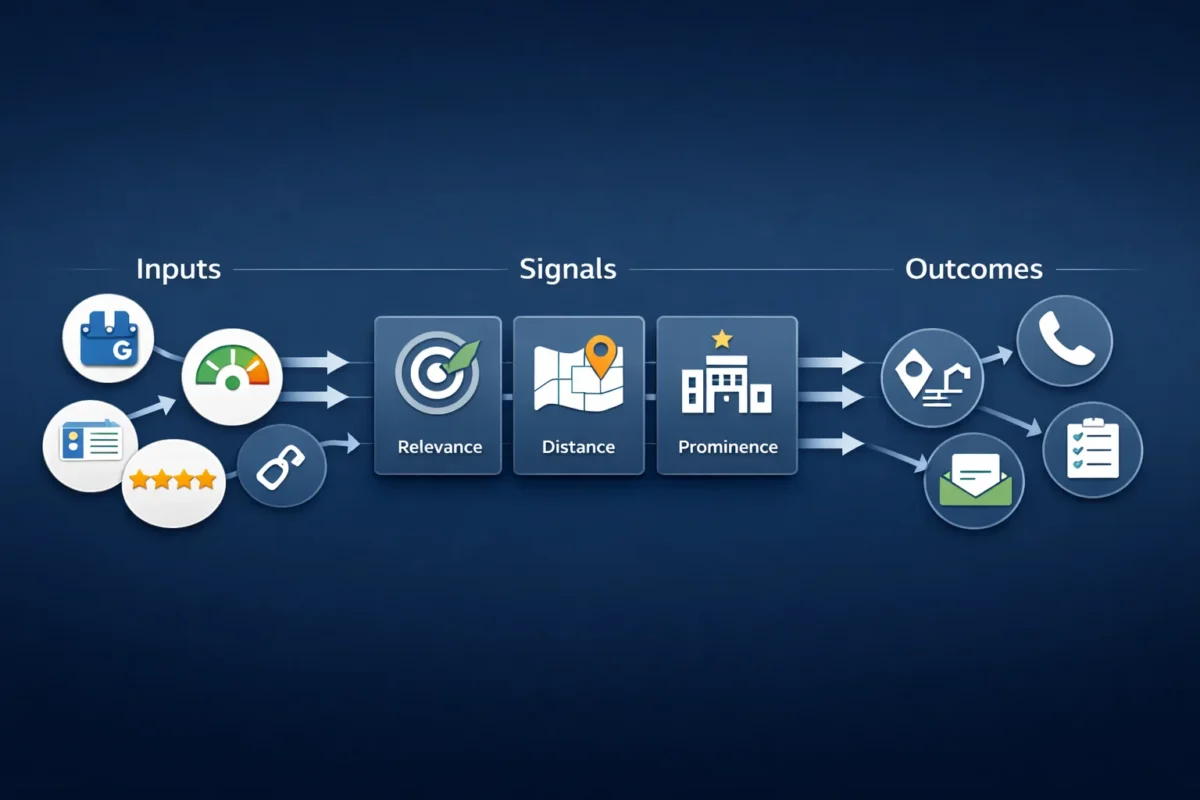
A practical model is:
- Inputs: GBP accuracy, website clarity, site speed, NAP consistency, reviews, local links/mentions
- Signals: relevance, distance, prominence (the three local ranking factors)
- Outcomes: impressions → clicks → calls/directions/forms → enquiries → revenue
What mistake costs a small business owner the most here?
Paying for ongoing SEO without knowing which input is broken. That is how owners fund months of work that cannot move the needle.

“We don’t show up on Google” is usually a foundation problem, not a content problem
When a small service business says, “we don’t show up on Google,” the fastest path is a triage check, not a 12-month blog plan.
The 15-minute triage we run before touching anything
1) Site speed (mobile first)
A slow site creates friction for users and weakens most downstream metrics. If pages load sluggishly, click-through and conversion suffer, even if rankings improve.
2) NAP consistency (name, address/service area, phone)
The NAP must match between the website and GBP. When details conflict, Google sees ambiguity. Ambiguity reduces confidence. Reduced confidence tends to reduce visibility. (Yeah, its like a domino effect)
3) Backlink profile (especially local links/mentions)
If a business has no credible mentions or links, Google sees a business that is hard to verify in the local ecosystem. If it sees generic links, it doesn’t attach local relevance.
Bonus: the 5-second homepage test (the conversion leak most owners miss)
In five seconds, can a human clearly answer:
- Who are you?
- What do you do?
- Who do you serve (and roughly where)?
If not, the site often struggles to rank and convert regardless of how many “SEO tasks” you do.
Failure scenario example (how money gets wasted)
- Scenario: A plumber pays $800/month for “local SEO” for six months.
- What the agency delivers: weekly posts, a handful of generic blogs, a citation package, and a ranking screenshot.
- What was never fixed: GBP is incomplete, service categories don’t match reality, NAP differs across pages, the site loads slowly on mobile, and the homepage doesn’t clearly state service areas.
- Outcome: Some impressions rise, but calls stay flat. The owner concludes “SEO doesn’t work” when the truth is simpler: the wrong bottleneck was funded. Business owners tend to think of SEO as just “more” content, because it is easy to measure output. This is why sites often get stuck beyond page 2, because they produce more of the same “stuff” that isn’t working.
What mistake costs the most money here?
Buying “4 blogs a month” or “50 citations” while speed, NAP, GBP clarity, and conversion structure remain broken.
Trade-off: Foundation work is less glamorous, but it stabilises visibility faster. Prominence work (reviews and local trust) takes longer, but it is more defensible.
If you’d like clarity on where the leak is, start with a local SEO audit.

Google Business Profile is the highest-leverage local SEO asset, and also the highest-risk asset
Google Business Profile (GBP) is your public business identity inside Google’s ecosystem. It influences visibility and actions (calls, direction requests, website clicks). A lot of businesses do not have an “SEO problem.” They have a GBP clarity problem.
The most common policy-related risk is not dramatic wrongdoing, it is confusion and incompleteness
The most common issue we see is:
- missing fields
- unclear services
- mismatched messaging
- half-finished sections that reduce confidence
This can be fixed by completing and aligning the profile so everything flows and matches the website.
GBP completion checklist (service business version)
Use this as a practical “done/not done” list.
Identity
- Business name matches real-world branding (no taglines stuffed in)
- Primary category selected accurately
- Secondary categories used only when genuinely applicable (and match your website service categories)
Contact
- Phone number correct and consistent with the website
- Website URL correct (and points to the right page)
- Service area set correctly (especially for service-area businesses)
- Hours accurate (including public holidays if relevant)
Services and offers
- Services listed properly (not just mentioned in posts)
- Service descriptions match what you actually sell (avoid vague fluff)
Trust
- Photos that show real work, team, premises or service process (Stock photos won’t work here)
- Review responses are consistent (calm, professional, human)
- A simple review request system exists (more on that below)
What mistake costs the most money here?
Letting an agency “optimise” GBP aggressively without risk management, or letting GBP sit incomplete for years while paying for everything else.
Trade-off: Fast changes can produce short-term movement, but aggressive changes can trigger instability. GBP is an asset, treat it like one. If your profile feels messy or inconsistent, a focused Google Business Profile optimisation service is often safer than random tweaks.

Local ranking factors are practical levers, not theories
Local results are shaped by relevance, distance, and prominence. These are not abstract concepts, they map to specific actions.
Relevance increases when Google can confidently match your business to intent
What does this mean?: Relevance is how clearly Google understands what you do, for whom, and where you do it.
Fast relevance boosters we see work in real projects:
- Local backlinks from real community sources (clubs, chambers, partners)
- NAP consistency between GBP and the website
- Clear service-to-page mapping (service pages that match real services)
What mistake costs the most money here?
Assuming relevance is created by repeating suburb names on the homepage. If that worked, everyone would rank by stuffing locations into text, so don’t do it. (However “Do” state the suburbs that you service, just not 50 times)
Distance is not something you can “SEO your way around”
Distance is proximity between the searcher and the business/service area, plus practical travel reality.
A clean explanation: if you are in the Barossa, do not expect to dominate searches in McLaren Vale. That is not pessimism, it is how local results behave.
Tactics we refuse to use: “fake distance” strategies like spamming location pages for regions you do not genuinely serve.
Trade-off: tighter service area targeting often wins faster; broad targeting costs more and takes longer.
Prominence is what trust looks like when you are not famous
Prominence is a mix of:
- reviews (and responses)
- credible mentions/links
- consistent identity across the local web
Two ethical prominence builders that work for small operators:
- a review system built into invoices/emails
- local relationships that naturally earn mentions and links
What mistake costs the most money here?
Buying shortcuts (paid reviews, low-quality links, bulk directory blasts). They either do nothing or create long-term risk.
The most wasted SEO spend happens when rankings rise but enquiries do not
When owners say, “We’re getting traffic, but nothing is happening,” that is usually a hidden bottleneck.
Decision framework: the Local SEO Bottleneck Ladder
Use this ladder to diagnose where money is leaking:
- Visibility problem (not appearing)
Fix: GBP accuracy, NAP consistency, speed, core relevance - Click problem (appearing but not getting clicks)
Fix: categories, photos, review strength, offer clarity, titles/meta - Conversion problem (clicks but no enquiries)
Fix: messaging clarity, service pages, proof, contact friction, trust - Sales problem (enquiries but low close rate)
Fix: positioning, pricing clarity, follow-up systems, service framing
What mistake costs the most money here?
Paying for “more SEO” when the bottleneck is conversion. You can rank first and still lose.
If your site gets traffic but not enquiries, prioritise building an effective business website before buying more content.
A minimum viable website for local SEO is small, clear, and trustworthy
For local service businesses, our minimum viable build is:
- Home
- About
- Contact
This is not a design preference. It is a trust structure.
Why the About page matters more than most people think
A strong About page helps:
- customers trust you
- Google see a legitimate entity
- reduce “thin business” signals
Service pages are the ranking + conversion bridge
Service pages connect:
- what people search
- what you offer
- where you offer it
- what the next step is
A practical rule: do not force your homepage to rank for everything. Build service pages that match clear intent and target specific keywords (Service + Geographical Location).
What mistake costs the most money here?
A beautiful site that does not communicate the service and service area quickly, or makes contact details hard to find.
Trade-off: fewer strong pages vs many thin pages. Thin pages are easier to write but harder to trust and rank.

Location pages help only when they reflect real service delivery
Location pages can work. They also become expensive “SEO theatre” when used badly.
Decision rule for location pages (service-area businesses)
Create location pages when:
- you have real clients in that area (or it is adjacent to areas you serve strongly)
- you can include real proof and specificity (not copy/paste)
Avoid location pages when:
- you are targeting areas far outside practical distance
- pages would be thin and repetitive
Good vs poor execution (clear comparison)
Poor execution
- dozens of near-identical suburb pages
- generic paragraphs with swapped suburb names
- no proof, no constraints, no local specificity
Good execution
- one strong regional page plus a few adjacent area pages
- clear service boundaries and practical constraints
- FAQs that reflect local concerns
- evidence: photos, reviews, examples of work delivered locally
What mistake costs the most money here?
Paying for 30 suburb pages that do not rank and dilute quality.
Reviews and local links build prominence ethically, and both can be systemised
Reviews: what to avoid and what works for small operators
Avoid: paying for reviews. It is a trust-killer and can backfire.
What works: a “soft ask system” built into normal touchpoints. For example, add a small review link line to:
- invoice emails
- job completion follow-ups
- thank-you messages
Example review footer (copy/paste)
“Thanks again for choosing us. If we did a good job, a quick Google review helps more than you’d think: [review link]”
What mistake costs the most money here?
Treating reviews as a once-a-year push instead of a systemised ongoing process.
Local links: what we stopped doing and what we do instead
We used to do broader directory-style backlinking. The problem is simple: volume is not relevance.
Now we focus on:
- credible, locally relevant links and mentions
- selective directories with real authority
- community sources (local organisations, partners, chambers)
A practical quality filter (quick test)
- Would a local customer realistically discover you there?
- Is the site maintained and credible?
- Is the category relevant to your service?
- Does it look like a link farm? (check the Domain Rating using tools like Ahrefs backlink checker)
What mistake costs the most money here?
Buying bulk links or citation blasts with no quality control.

Local SEO maintenance is small when foundations are strong, but never “set and forget”
A realistic cadence depends on authority:
- starting from zero: often ~4 helpful articles per month initially, then reduce
- with authority: often ~1 quality article per month plus trust work
Maintenance also includes:
- updating GBP
- adding photos periodically
- responding to reviews
- watching for NAP drift and duplicates
What mistake costs the most money here?
Stopping after a short improvement, then wondering why calls flatten six months later.
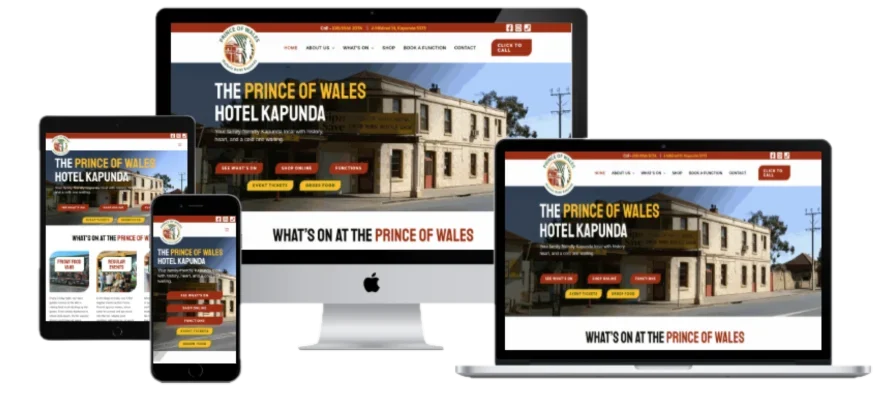
Mini case breakdown: Kapunda pub — what changed, what moved first, and what we measured
A pub/hotel in Kapunda wanted to be easier to find and more compelling when found.
Baseline (what was happening)
- They needed a website to provide clarity (who/what/where quickly)
- GBP was under-utilised and not aligned well with their services
- Reviews existed, but there was no consistent system to build trust further
Diagnosis (what mattered most)
We focused on leverage:
- clarity and consistency first (website + GBP alignment)
- trust signals next (reviews system and prominence)
Actions taken (what we actually changed)
- tightened website clarity and service framing (who/what/where)
- aligned GBP services and messaging to match the website
- improved the review system and made it easier for happy customers to leave feedback
What moved first (leading indicators)
- improved profile engagement (more meaningful actions)
- stronger consistency signals between GBP and website
- increased visibility leading to measurable traffic improvement
Outcome
The website reached roughly 200 visitors per month within about two months after the core improvements and trust signals were strengthened.
What mistake costs the most money with case studies?
Chasing the “tactic” instead of the sequence. The sequence: clarity → alignment → trust (is usually the win).
Local SEO cost in Australia is clearer when you separate foundation from growth
Costs vary because businesses start with different bottlenecks. Still, owners deserve ranges to sanity-check decisions.
A transparent cost model (indicative ranges, not quotes)
1) Foundation cleanup (one-off sprint)
- Purpose: fix speed, NAP/consistency issues, GBP clarity, core pages, tracking setup
- Indicative range (AU SMB): $1,500 to $6,000 depending on severity and whether web work is required
2) Ongoing growth (monthly)
- Purpose: service page development, content, local links/mentions, review operations, reporting. While this all sounds like “More Content”, this should be developed as a content system. That is what you are paying for…
- Indicative range (AU SMB): $750 to $3,500/month depending on competition, geography, and execution scope
3) Rebuild + SEO alignment (project-based)
- Purpose: when conversion and clarity are structurally broken on the website and google business profile, sometimes you just have to roll a hand grenade and get ready to build it from new.
- Indicative range (AU SMB): $4,000 to $15,000+ depending on complexity and content requirements
These are not promises or quotes. They are practical ranges to help you avoid the most common trap: paying monthly for activity when a short foundation sprint would have unlocked outcomes faster.
What mistake costs the most money here?
Choosing a cheap monthly package that cannot diagnose or fix bottlenecks, then staying on it for six months because “SEO takes time.”
Measuring local SEO without fooling yourself requires a simple dashboard
Good measurement is not complex; it is consistent.
Leading vs lagging indicators (structured ROI perspective)
Leading indicators (early movement)
- GBP impressions and actions (calls, directions, website clicks)
- keyword footprint growth
- meaningful rank movement (e.g., page 40 → page 3)
- click-through rate improvements
Lagging indicators (business outcomes)
- qualified enquiries
- revenue
- customer acquisition cost
What to track weekly vs monthly
Weekly
- GBP actions (calls/directions/clicks)
- enquiry count (forms + calls you can attribute)
- obvious tracking issues (broken forms, wrong phone number)
Monthly
- Google Search Console trends (queries, clicks, pages gaining traction)
- conversion rate improvements
- review velocity and response consistency
What mistake costs the most money here?
Judging success by rankings alone. Rankings can move without revenue moving if conversion is broken.

Most agency manipulation tactics are ways to hide low-leverage work
This matters because it protects your budget.
Common patterns that waste money:
- “More content” as the default answer (even when foundations are broken)
- bulk directories/citations without relevance checks
- ranking guarantees
- geo-page explosions sold because they are easy to produce
What most agencies won’t tell you:
Small businesses usually need fewer actions done in the right order, not more actions done monthly.
What mistake costs the most money here?
Signing a long retainer before diagnosis and a prioritised plan from that agency.
Key Takeaways
- Local SEO is a system: fix inputs before buying activity.
- The fastest triage is speed + NAP + backlinks, plus the 5-second homepage clarity test.
- GBP is high-leverage; complete and align it before chasing advanced tactics.
- Location pages work only when they reflect real service delivery and local proof.
- Rankings without enquiries is usually a conversion bottleneck.
- Ethical prominence is built with reviews and local trust signals, not shortcuts.
- Separate foundation pricing from growth pricing to avoid wasted spend.
Summary diagnostic table: symptom → likely cause → what to fix first
| Symptom | Likely cause | What to fix first |
|---|---|---|
| Not showing in Maps or local results | NAP inconsistency, weak GBP setup, no local trust signals | NAP alignment + GBP completion + initial local links |
| Showing sometimes but inconsistent | Profile confusion, duplicates, unstable edits, weak prominence | GBP cleanup + review system + controlled updates |
| Impressions rising but clicks flat | Category mismatch, weak photos/reviews, unclear offer | GBP categories/services + photos + review strength |
| Clicks rising but enquiries flat | Website messaging unclear, contact friction, weak trust | Homepage clarity + service pages + proof + contact flow |
| Enquiries up but sales flat | Positioning/pricing clarity, follow-up process | Offer framing + pricing thresholds + follow-up system |
Decision Summary: what to fix first
- Speed + mobile usability (remove friction)
- NAP consistency across website + GBP (remove ambiguity)
- GBP completeness + clarity (increase confidence)
- Homepage + service pages that convert (turn clicks into enquiries)
- Ethical prominence system (reviews + local links/mentions)
Fast-moving signals: speed, NAP alignment, GBP completeness
Defensible signals: reviews, credible local links, consistent reputation operations

FAQ
How much does local SEO cost in Australia?
Local SEO cost in Australia typically splits into a foundation sprint ($1,500–$6,000 indicative) and ongoing growth ($750–$3,500/month indicative). The right spend depends on the bottleneck: foundations, prominence, or conversion.
How long does local SEO take to work?
Foundation fixes can show movement within weeks, while prominence (reviews and local trust signals) often takes months to compound. Track leading indicators first, then revenue outcomes.
Do I need a website rebuild for local SEO?
Not always. If speed, clarity, and conversion paths can be fixed without rebuilding, targeted improvements may be enough. A rebuild is most valuable when the site cannot clearly communicate the service and service area or cannot convert traffic into enquiries.
What should I fix first when I don’t show up on Google?
Start with site speed, NAP consistency between website and GBP, and GBP completeness. Then build ethical prominence through reviews and locally relevant links.
Should I create location pages for every suburb?
No. Location pages work when they reflect real service delivery and include local proof. Thin suburb pages often waste money and dilute quality.
How do I evaluate a local SEO agency?
Look for diagnosis-first thinking, clear reporting, a policy-safe approach to GBP, and honest trade-offs. Avoid ranking guarantees, bulk directory packages, and mass suburb-page proposals without evidence.
What is the biggest local SEO mistake small businesses make?
The biggest mistake is paying for ongoing SEO activity before fixing foundational clarity: speed, NAP consistency, GBP completeness, and conversion structure.